Is the NCLEX Harder Than The BAR Exam? Learn Their Differences
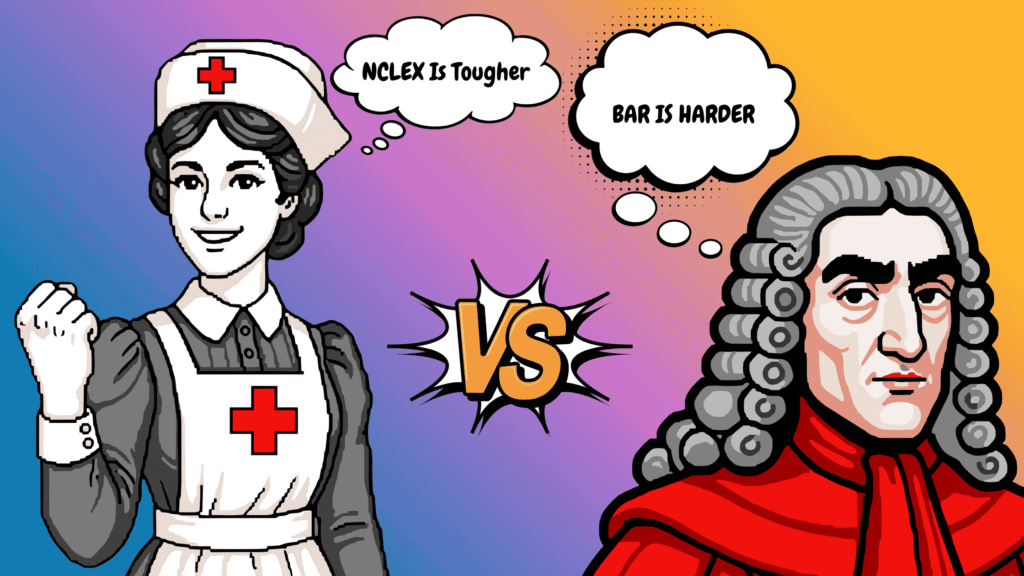
No, the NCLEX is not harder than the Bar Exam. NCLEX has an 80% first-time pass rate, testing nursing judgment via adaptive questions. The Bar Exam averages 60–70%, covering 7–10 legal subjects with essays. Statistically, the Bar is harder.
I recently came across a debate on Reddit about whether the Bar Exam or the NCLEX is more difficult than the other.
When people argue about whether the NCLEX or the Bar exam is harder, they’re usually coming from their own field’s trauma, and honestly, both sides have a point. But when you step back and look at structure, scope, and pass rates, the Bar exam is generally viewed as the tougher of the two, even though the NCLEX brings its own unique kind of pressure.
The difference comes down to what each exam is trying to prove. The Bar is testing whether you can handle the full complexity of legal reasoning across multiple domains, while the NCLEX is testing whether you can make safe, real-time clinical decisions that protect patients.
Which Exam is More Difficult? Bar vs NCLEX
NCLEX (Nursing Licensure)
- First-time pass rate: ~87–89%
- Adaptive exam (~5–6 hrs)
- Focus: clinical judgment, prioritization, safe patient care
- Preparation: Weeks–months
Bar Exam (Law Licensure)
- First-time pass rate: ~55–79% (varies by state)
- Multi-day exam (~12+ hrs)
- Focus: legal analysis, issue spotting, essays, performance tasks
- Preparation: Months of intensive study
Most experts and test-takers consider the Bar exam more difficult overall, and that reputation largely comes from its massive content load and historically lower pass rates.
The Bar covers a wide range of detailed legal subjects and stretches over multiple days, requiring sustained performance in essays, multiple-choice sections, and performance tests that simulate real legal tasks.
By comparison, the NCLEX focuses on nursing practice, clinical judgment, and patient safety, and although candidates often say the questions feel unfamiliar or tricky, especially with multi-select and case-based formats, first-time pass rates are generally higher than those seen on the Bar.
Exam Structure: NCLEX Vs BAR
| Feature | NCLEX (Nursing) | Bar Exam (Law – UBE) |
|---|---|---|
| Purpose | Nursing Licensure | Law Licensure |
| Exam Format | Computerized Adaptive Testing (CAT) | Fixed-format exam (same test for all takers) |
| Delivery Method | Computer-based at Pearson VUE centers | In-person testing (paper or laptop-based) |
| Length | Up to 5–6 hours | Typically 2 days (~12 hours total) |
| Number of Questions | Varies (adaptive; minimum to maximum range) | 200 multiple-choice + 6 essays + 2 performance tasks |
| Question Types | Multiple choice, SATA, case studies, drag-and-drop, hotspot | Multiple choice (MBE), essays (MEE), performance tests (MPT) |
| Adaptive? | Yes | No |
| Scoring | Pass/Fail based on competency standard | Scaled score combining all sections |
| Skills Assessed | Clinical judgment & safe patient care | Legal analysis, writing, and lawyering skills |
The Bar exam typically runs over two to three days and includes long multiple-choice sessions (like the Multistate Bar Exam), written essays, and performance tests where you analyze legal materials and produce written work under time pressure.
You’re not just recalling rules; you’re applying law in structured arguments for hours at a time.
The NCLEX, on the other hand, is taken in one sitting and uses computerized adaptive testing, where question difficulty changes based on your performance.
Instead of writing essays, you’re making rapid clinical decisions, prioritizing patient care, and analyzing case scenarios. The focus is less on memorizing legal rules and more on safe nursing judgment.
People who’ve taken both types of exams often say the Bar feels overwhelming because of the sheer volume of content, while the NCLEX feels mentally intense because every question demands careful, safety-based reasoning.
Bar Vs NCLEX Pass Rates
| Exam | Candidate Type | Typical Pass Rate | Notes |
|---|---|---|---|
| Bar Exam (U.S.) | All Test-Takers | 55–60% | Includes repeat candidates; varies by state and exam session. |
| Bar Exam (U.S.) | First-Time (ABA Law Grads) | 80–83% | Higher summer pass rates; top schools may exceed 90%. |
| Bar Exam (U.S.) | Ultimate Pass Rate (2 Years) | 90%+ | Accounts for multiple attempts within two years. |
| NCLEX (RN) | All Test-Takers | 72–88% | Depends on year and exam version (Next Gen NCLEX). |
| NCLEX (RN) | First-Time U.S.-Educated | 85–90% | Higher than repeat or international candidates. |
| NCLEX (RN) | Repeat / International | 30–50% | Lower pass rates compared to first-time U.S. test-takers. |
This is not the conclusive way to compare, but it can explain which one has the higher cutoff rate.
First-time NCLEX-RN pass rates for U.S.-educated graduates have often landed in the high 70% to high 80% range, with some fluctuations during certain years and changes in exam format.
The Bar exam, in contrast, typically sees overall pass rates closer to the 60% range, with first-time takers doing better than repeaters but still facing a tougher statistical landscape than NCLEX candidates.
These numbers don’t tell the whole story, but they do show that a larger proportion of NCLEX test-takers succeed on their first attempt compared to Bar exam candidates, which supports the idea that the Bar presents a broader and more difficult hurdle in terms of raw pass-rate outcomes.
Most Challenging Question Types
| Exam | Challenging Question Type | Why It’s Difficult | Primary Skill Tested |
|---|---|---|---|
| NCLEX | NGN Case Studies (Clinical Judgment) | Multi-part patient scenarios requiring cue recognition, analysis, prioritization, and evaluation across evolving data. | Clinical reasoning & decision-making |
| NCLEX | Select-All-That-Apply (Extended Multiple Response) | Multiple correct answers; precision required; partial credit scoring increases analytical pressure. | Analytical accuracy & knowledge integration |
| NCLEX | Matrix/Grid & Bow-Tie Items | Requires classification, pattern recognition, and linking conditions to interventions. | Multidimensional thinking |
| Bar Exam | Multistate Performance Test (MPT) | Simulated real-world legal tasks under strict time limits; requires structured written analysis. | Practical lawyering & written communication |
| Bar Exam | Multistate Essay Examination (MEE) | Rapid issue spotting and rule application in 30-minute timed essays. | Legal analysis & structured writing |
| Bar Exam | Multistate Bar Examination (MBE) | Nuanced fact patterns with plausible distractors; tests fine distinctions in legal doctrine. | Doctrinal precision & applied reasoning |
NCLEX
Under the Next Generation NCLEX, many candidates say the hardest parts are case studies and multi-response questions, because these require you to track a patient scenario across several steps and apply clinical reasoning repeatedly.
Select-all-that-apply items are especially stressful since missing even one correct option can hurt your performance, and many of these newer items involve layered data like labs, charts, and evolving symptoms.
Pharmacology and med-surgical integration questions also tend to feel difficult because they combine knowledge, prioritization, and safety in one decision.
Bar Exam
For the Bar, the Multistate Bar Exam multiple-choice section is often described as brutal due to tricky wording and deep rule distinctions in subjects like Property, Contracts, and Evidence.
But the written portions are just as critical because essays and performance tests require fast issue-spotting, structured legal analysis, and clear writing under serious time pressure.
Many candidates find that sustaining that level of analytical output for multiple days is one of the most exhausting aspects of the Bar experience.
Top 10 Hardest Exams in the U.S.
Uniform Bar Examination
Notoriously difficult, especially in some jurisdictions.
USMLE (Medical Licensing Exam)
High-stakes exam for physicians requiring extensive preparation.
Patent Bar Exam
Specialized bar for patent attorneys; requires technical and legal knowledge.
CPA Exam
Finance-focused high-stakes licensure with multiple sections.
CFA Exams
Three-level finance certification with notoriously low pass rates.
MCAT
Standardized test for med school admission; tests reasoning and science knowledge.
LSAT
Exam testing logical reasoning, reading comprehension, and analytical thinking.
GRE
Required for many competitive graduate programs; tests verbal, quantitative, analytical skills.
FE & PE (Engineering Licensure)
Professional engineering exams testing technical and applied knowledge.
NCLEX-RN
Nursing licensure exam emphasizing clinical judgment and patient safety.
When people rank the toughest U.S. exams, the NCLEX and Bar often appear alongside other high-stakes, high-difficulty tests that demand massive preparation and carry serious career consequences.
Each of these exams is known for either low pass rates, enormous content volume, complex reasoning requirements, or all three.
The Bar stands out for its multi-day legal analysis demands, while the NCLEX stands out for its adaptive format and real-world safety focus.
So, Which Exam Should you choose?
If you’re trying to decide which is “harder,” the honest answer is that they’re difficult in different ways, because they test completely different skill sets.
The Bar leans heavily on extensive legal knowledge and written analysis over multiple days, while the NCLEX leans on rapid clinical judgment, prioritization, and safe decision-making in an adaptive system that never lets you relax.
Statistically and structurally, the Bar is usually considered the more difficult exam overall, but the NCLEX remains one of the most challenging healthcare licensure tests, especially because every decision you make is framed around patient safety and real-world consequences.